Long stapler
The Portable DoorThe Long stapler is an unsettlingly mobile office implement whose ordinary function gives way to several extraordinary ones: it becomes Paul Carpenter’s weapon against a Goblin, a makeshift doorstop, and the apparent prison of John Wellington Wells. Its repeated arrivals in the right place make it more than a useful prop. It is a material thread through Paul’s growing involvement with J.W. Wells & Co.’s magic, culminating in the discovery that the familiar object has concealed a person.
Office Tool and Recurring Presence
The stapler first enters this part of Paul’s story as a missing piece of office equipment. Sophie Pettingell returns from the broom cupboard triumphantly holding it, wondering how it got there, while Paul is still struggling with copied spreadsheets and has not made it halfway through them. When he tries to account for his delay, he mentions the old, thin Professor Van Spee, then pretends he has forgotten the professor’s name. In this mundane workroom exchange, the stapler is simply something to be found and returned; its unexplained location is a small oddity beside the larger strangeness Paul is avoiding discussing.
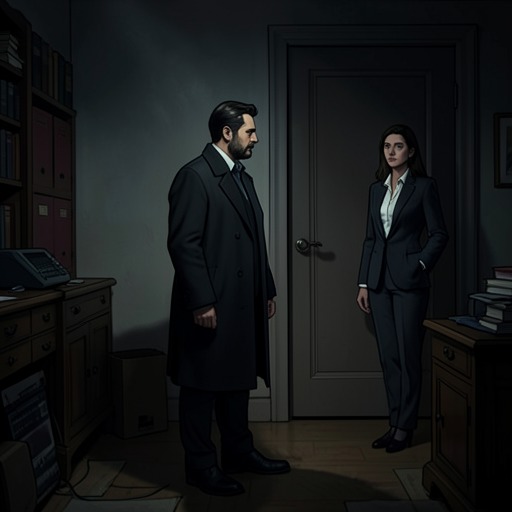
That apparent ordinariness does not last. During the Goblin attack, Paul reaches for something cold and smooth while backing away from a much larger attacker armed with a knife and a spiked iron club. The object proves to be the Long stapler. Paul has no weapon suited to the fight, but he strikes the Goblin’s claw with the stapler, then catches its arm and clamps the device over the creature’s palm. The stapler clicks; the Goblin shrieks and drops its knife. Paul staples it a second time before it pulls free. His improvised defense is effective not because the object was designed for combat, but because its jaws can be turned into a painful means of resistance.
A Weapon Made by Circumstance
The fight also shows how the surrounding office joins the stapler in changing function. The Goblin backs into a bookshelf supporting 103 bound volumes of the Journal of Meteorological Studies, covering June 1949 to December 1957. Its helmet spike breaks one of the wooden brackets, and the shelf gives way. The falling books rain down on the attacker, with a volume from February 1956 delivering the final blow described in the scene. The stapler does not defeat the Goblin alone: Paul’s desperate use of it, the creature’s movement, the vulnerable bracket, and the heavy reference books combine to reverse the attack. A desk tool becomes a weapon within a larger accident of objects and motion.
Paul’s later familiarity with the stapler’s uncanny appearances is presented as a change in his expectations. After discovering another strange object in a desk drawer, he notices the Long stapler there as well and treats its presence as something he is used to, despite having last seen it in reception and not seeing anyone carry it into the room. The same drawer also contains chocolate-covered raisins and a rolled sheet that Paul recognizes as a Portable Door like the one previously found in the strongroom, though with differences in its markings and moulding. The stapler’s recurring placement beside such consequential objects makes its unexplained movement part of the office’s broader magical disorder.
The Doorstop and the Door
The stapler’s usefulness shifts again when Paul reads the Portable Door’s instructions. They advise holding the door ajar with a convenient object of suitable weight. The stapler is on the desk, shaped in Paul’s view like a thin black rabbit, and appears to be the only suitable makeshift doorstop in the room. Although he is already accustomed to finding it where it should not be, he has no explanation for its arrival. He picks it up, reaches for the doorknob, and the door opens; once open, it acquires visible weight and depth, with its frame, lintel, and mouldings standing out as a real door.
The scene gives the stapler a precise practical role without making it the source of the door’s magic: it supplies the weight needed to keep the Portable Door ajar during use. Yet its persistent availability feels increasingly purposeful. An object that had just helped Paul fend off a Goblin now assists his passage through a magical threshold, carrying an everyday office function into a world where doors can be unfolded, opened, and made substantial.
The Reflection and John Wellington Wells
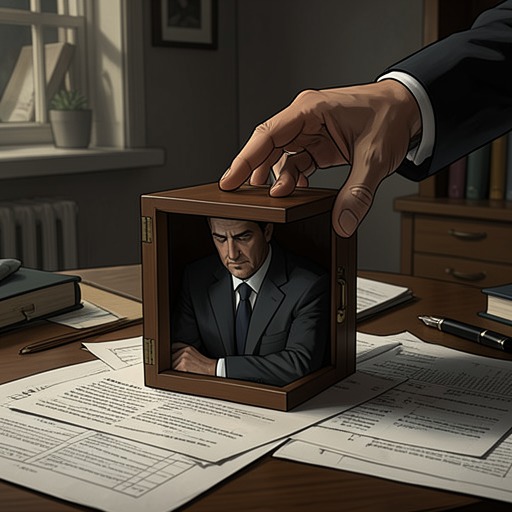
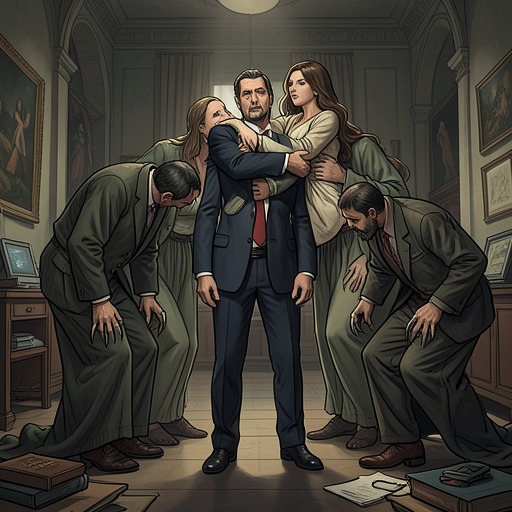
The stapler’s deepest significance is disclosed in the boardroom confrontation with Humphrey Wells. As Humphrey prepares to use a love philtre to manipulate Sophie, Paul looks down at the mirror-polished table and sees the stapler reflected there. The reflected image is not merely the inverted image of an office tool: it shows a tiny, bald man in a black frock coat and grey striped trousers, crouched and waving. Paul recognizes him as John Wellington Wells, who has been missing. Earlier, the same table’s unusual reflective power had revealed Kurt Lundqvist in the form of a mouse; here it exposes the human identity hidden within the stapler.
John speaks faintly inside Paul’s head and gives him an instruction: when the spell breaks, Paul must lay the chain over the stapler. The unseen restraints release Paul, who falls forward and reaches for the little gold chain as Humphrey turns with a sword raised. Paul flicks the chain toward the stapler. It clatters against it and wraps around it like a bolas; a blinding blue flash follows, and John steps down from the table. The stapler’s appearance as a tool has concealed a captive person, and the chain transforms recognition into rescue.
Release and Retrospective Meaning
John’s release sets off several changes at once. Humphrey is bound by a suddenly appearing snake; Sophie, who had been affected by the philtre, falls asleep; and John spits out staples. The last detail makes the stapler’s former identity physically present even after John has stepped free. Paul later explains the sequence to Sophie, identifying the long-staying, long-disappearing stapler as the lost John Wellington and recalling that the mirror showed him as he really was. His account makes explicit what the object’s appearances had only suggested: its unexplained mobility was connected to the captive being hidden inside it.
Across these episodes, the Long stapler moves from office inconvenience to improvised defense, practical aid, and concealed person. Its significance rests on the contrast between what it seems to be and what it can do. The same jaws that fasten paper injure a Goblin; the same object that appears on desks and in drawers serves in a magical escape and bears the chain that frees John. The stapler’s ordinary shape does not disappear when its secret is revealed. Instead, its routine presence becomes newly legible as a sign that something human has been concealed in plain sight.